
Sand Tray Therapy
 Here we go again.
It is Monday morning, and your alarm goes off for school. You have to get yourself up, get ready for school, pack your lunch, and see yourself off. And to make matters worse, when you get to school, you have no one who is waiting to talk to you.
You know you will sit alone in the cafeteria. You know you will get picked last for teams in PE. And you know you will play by yourself at recess. You just don’t feel like you fit in anywhere.
Thankfully…
You have music today, and you really like your music teacher. They make the room light up for you. Additionally, you love to sing, so it makes that class period extra special…
…even though at the end of the day you will go home to an empty house.
Depending on the age at which this started, or what the actual trauma is for this little girl, it might be challenging for her to share exactly what is going on for her. Perhaps she feels lonely, and it’s vulnerable to share that. Perhaps she feels shame – her clothes aren’t cool, or “all” the other kids are athletic, or she is the “only one” who goes home to an empty house.
Sometimes, the trauma is just too deep to process in words. In these cases, we use a technique that touches our sense of creativity and allows for digging deep without having to attach words to it.
Sand tray therapy can help a child and adults, too.
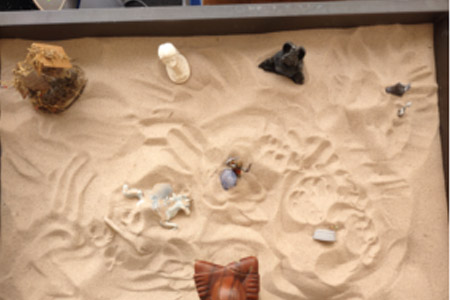
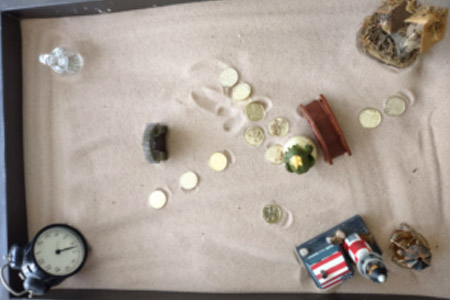
Through guiding the individual to think about something that made them unhappy, and using miniature toys and figures to put that ‘story’ into a landscape in the sand, we dig deeper into the wound than words allow.
Words often aren’t needed – that adage, ‘A picture is worth a 1,000 words,’ can be true in sand tray therapy.
If your child is suffering – or if you have unprocessed painful memories – the sand tray therapy may be the key to loosening the hold of the traumatic memory.